 |
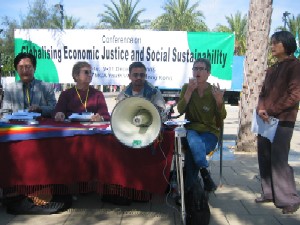
| (右起)記者會主持胡露茜、Jane Kelsey、 印度People's Vigilance Committee on Human Rights召集人Lenin Raghuvansi、 Ofelia Ortega,以及Josef Widyatmadja。 |
該會議有二百多名來自廿九個國家不同宗教的人士參加。他們於十一日上午的記者會發表致信仰群體的公開信,指經濟全球是反生命、反人民、反創造中的融貫、反公義和反和平。所有信仰群體必須一致向後自由主義和世貿說「不」。公開信進一步指,若然接受當今「市場原教旨主義」形式(market fundamentalism)的全球化進程,並認為別無他途,就是罪(Sin)。公開信指,信仰群體應致力於人民福祉,並鼓勵另類農業、生計及經濟模式。
記者會於銅鑼灣維多利亞公園舉行。出席記會的紐西蘭奧克蘭大學法律系教授Jane Kelsey相信,區域性的貿易協議(例如南半球的貿易圈)遠比全球劃一的貿易協議好,較能照顧個別國家的獨特需要,避免現時世貿所產生的問題。她說,世界各地很多社群過著跟香港不同的生活和經濟模式,但這些另類模式和生計正備受催殘。
Kelsey指,世界強權從不容許全球出現另類經濟模式,為了謀利忘記公義。而世貿強制要求成員國,其本身所簽的區域貿易協議改以世貿的協議為基礎。雖然不少貧窮國家曾討論如何建立區域性的另類貿易協議,但在此之先他們須脫離世貿。
亞洲基督教議會(CCA)代理副總幹事Josef Widyatmadja在記者會上批評世貿總幹事拉米早前「世貿是為了財富創造,不是為了財富分配」的言。他說,製造財富沒問題,但這財富到底如何創造,又為誰創造?Widyatmadja說,香港人民熱愛和平,亦多年生活於和平之中;而得和平的重要因素是人人得公平和飽足。然而世貿並不帶來公平和食物,而是帶來饑餓和迷失。他說,世界各國的人民來到香港,就是為了要表明大家熱愛和平,而食物亦應彼此分享。「你從農夫手上奪去食物,即是奪去他們的生命。……食物為養生,而不是為謀利。」
關於過去世貿會議多次出現的暴力示威,Kelsey表示其實上屆墨西哥坎坤(Cancun)的世貿會議,只有一宗韓國農民自殺事件,並無其他暴力事件。她認為事件是被渲染了。她擔心港府的示威區太封閉,示威者有機會墮海而產生慘劇。而古巴Evangelical Theological Seminary的歐德嘉教授(Prof. Ofelia Ortega)則指,她們過去長年進行和平教育,暴力絕不是他們的意願。
而主持記者會的香港基督徒學會總幹事胡露茜則指,世貿的所作所為其實是更大的暴力。她指香港政府的渲染令香港市民視她們為敵人,但真正人類的敵人是這種極不公義極具壓迫性破壞力的所謂自由貿易的經濟發展。
Conference on Globalising Economic Justice and Social Sustainability
December 9-11, 2005.
Hong Kong
Message to the Faith Communities
We, 200 participants from 29 countries and different religious faiths, namely Hinduism, Buddhism, Christianity and Islam, who have met at Wu Kai Sha, Hong Kong, from 9-10 December 2005 to protest the ministerial meeting of the World Trade Organisation (WTO), and to work towards a vision on "Globalising Economic Justice and Social Sustainability", address the following message to the faith communities of the world:
We are meeting in Asia, the birth place of some of the world's great religions. Hinduism, Buddhism, Taoism, Judaism, Christianity and Islam all originated here. Despite the difference, faith communities hold fundamental values in common based on our belief in the Divine: the pursuit of truth and love, the assertion of equality of all human beings, respect for life and integrity of creation, the quest for peace and harmony, protecting the dignity of others, upholding justice and righteousness and compassion for those who suffer, who are poor and marginalized. Members of all faiths are involved in building sustainable communities with the participation of all. To us, as people of faith, it is imperative that these values be reflected in the economic and political order of our societies.
Today these values are under assault by transnational corporations and governments in their comprehensive pursuit of profits and economic growth. Economic globalization promoted by the WTO destroys the economic basis of communities in many parts of the world and causes irreversible damage to the natural resources of our world. The liberalizatio0n of financial markets allows for the uncontrolled flow of capital in search of the greatest gain. Investment is taking place where labour is cheap, labour rights are suppressed and where laws on industrial health and safety are lacking or not being implemented. Privatization results often in a drastic worsening of employment conditions and deprives the poor of essential services such as water, health and education. Deregulation of the economy destroys local manufacturing industries, creates unemployment and drives farmers and indigenous people from their land. Economic globalisation is anti-life, anti-people, anti-integrity of creation, anti-justice and anti-peace. Faith communities must say an unequivocal "No" to neo-liberalism and the WTO. It is sin to accept the proposition bhat there is no alternative to the present process of globalisation, in the form of market fundamentalism. The logic of globalisation leads to imperialist wars, conquest and plunder.
Motivated and sustained by faith we are committed to collaborate with people from different backgrounds to redress and transform the situation we face. Together, we must seek alternatives and work with social movements of resistance and transformation. Our aim is to establish a new social order based on ethics of the common good and ethics of care.
We call on our faith communities to:
- critically look at our complicity, and challenge our membership to dismantle the destructive structures within own institutions and to act as agents of transformation in a globalising context.
- move towards sustainable systems that celebrate life, hope and liberation, connect with the healing power of land and foster positive consumer-producer relationships that go beyond the exchange of goods, and include the exchange of stories and wisdom.
- engage in educational processes and aid in the creation of popular materials that are appropriate to the local population and mindful of language and culture, in order to expose how our governments are exploiting people and natural resources in the guise of free trade and increased market opportunity. Through education and action we must hold our governments accountable.
- work together with civil society and people's movements and take proactive roles in strengthening community-based organizations.
- create communities safeguarding rights of women, youth and children, and marginalized gropus.
- recognize the importance of the role of youth in carrying the vision of faith communities.
- uphold education as a right not a privilege and to orient it towards the needs and aspirations of communities rather than the market economy.
- use our resources for peoples' livelihood and promote sustainable agriculture/alternative livelihood options and peoples' economy.
- organize and participate in an interfaith round table conference during the World Social Forum, Nairobi 2007
- lobby our governments to get out of the WTO
- support and create a human and earth centered economy for life and peace
(http://www.christiantimes.org.hk,時代論壇時代講場,11.12.2005)