認真閱讀聖經的人,生活在兩端之間。
創世記清楚地傳達了上帝的心意,要我們為祂用愛和智慧去管治祂創造的世界。儘管後來人類偏行己路,但在挪亞出方舟後,上帝仍堅持祂的創造必須繼續昌盛。
來到現在,人類面臨著巨大的挑戰,令許多人感到絕望。流行的教導說災難性的「末日」即將來臨,這甚至被視為聖經預言。如果這是真的,認真的基督徒會成了悲劇英雄:上帝希望我為祂的創造盡我所能,但我所有的努力將會白費,因為上帝已經設定了創造被人類──甚至上帝自己──去摧毀。對某些人來說,這些先兆已很明顯,例如氣候變化和生態崩潰。
在這兩端中,第一端(上帝要我們照顧受造世界)是無可爭議的。第二端取決於我們如何閱讀啟示錄,就是聖經的主要終末(末世)文本。它的主幹包括三個「七」的系列:七印、七號和七碗。只有碗是上帝的憤怒,它只倒在罪人身上,而不在上帝的創造上。我們如何閱讀印和號角是關鍵。
別只著眼帶災馬,忘了良善的活物
如果只讀前四印中的四匹有色的馬,那麼只會看到災難:壓迫(白馬)、互相殺戮(紅馬)、稀缺(黑馬),最後是死亡(灰馬)。從這樣的閱讀開始,啟示錄接下來的大部份內容都被定性:一、未來是充滿災難;二、因為是羔羊揭開每一個印,所以上帝就是預定了這些災難;三、更嚴重的災難即將來臨;四、這一切都將導致人類和上帝的創造災難性的結局。
但是啟示錄的四馬只是經文的一半。整段經文還有四個獨特的活物,從美善上帝的寶座而出。每一個活物召喚一匹馬來。這起始的前四印最合理的意思是:上帝要人以威嚴(獅子)、忠誠(牛)、智慧(人)去統管受造世界,帶來不斷的更新(像飛鷹更新羽毛)。但人卻扭曲了上帝的心意,帶來剛剛相反的結果(馬的災難)。
以上不是別的解釋,而只是不折不扣地讀全文。這肯定:一、上帝要人類統管受造世界的不變意圖;二、那些災難來自人的歪曲;三、上帝仍然要人類通過適當管治來更新創造。隨後的段落(啟六9至十11)詳細闡述了這三點。
很奇怪地,我從來沒有找到任何人(學者或占卜者)正視文本要求的,將良善的活物和帶災難的馬之間的張力來解釋這個關鍵的開篇段落(啟六1-8)。他們只看到騎士。(請嘗試證明我錯了:[email protected])
然而,重述上帝對人類不變的要求只是信息的一半。人若是繼續犯罪,是不是說上帝的初心永遠成不了,這個世界還是滅亡?
創造.復活.終末
後半部份是:自稱為安息之主的耶穌不懈地在歷史中作工,去帶領人類和上帝的受造世界進入最終的安息,成就上帝的初心。
第六號角(啟十一)的最後一片段描述了這個壯舉。其中兩個上帝的見證人抵抗了外邦人對上帝聖城(受造世界)的踐踏,但被殺害了。然而,上帝叫這兩個見證人復活,並把他們帶到天上。
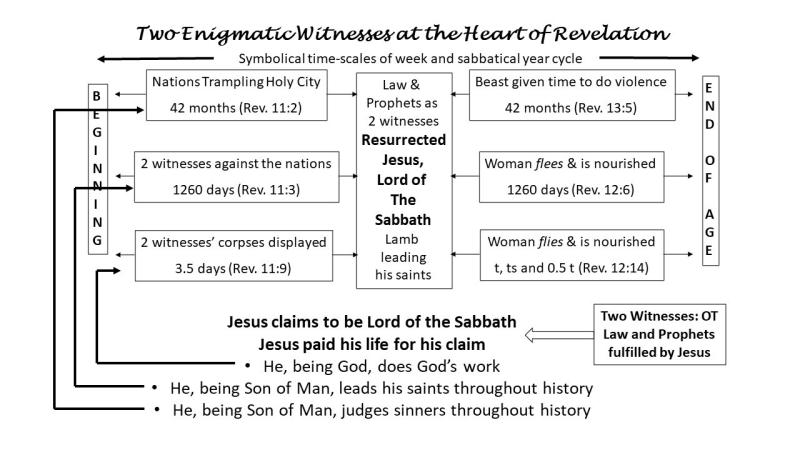
約翰深思熟慮地將這兩個復活的見證人(代表律法和先知)放在兩個安息時間尺度(上帝工作的一週;以及人類工作,將上帝的創造帶進安息的安息年週期)的中心。復活之前,是一套安息時間尺度的一半(42個月、1260日、3.5日);復活之後是另一半(42個月、1260日、「一載,兩載,半載」)。將它們匹配起來,就形成兩個完整的安息時間週期。
月份是根據管黑夜的月亮而設定,日是根據管白晝的太陽而設定。令人驚歎地,約翰將「月」只用於反對上帝的人,而「日」只用於上帝的追隨者,從沒有混淆。這說出那些人如何生活:是在黑暗中,還是在光明中!
這兩個見證人象徵著耶穌通過律法和先知在舊約中的工作。在耶穌成全律法和先知之後,從啟示錄十三章開始,祂以羔羊的身份出現。同一位耶穌正在推動受造世界從創造之初一直走往最終的安息,這充份說明耶穌在符類福音中,宣稱祂是安息之主的重大意義。
安息循環當中的耶穌
耶穌的復活是上帝工作(在3.5日+「一載、兩載、半載」中)的中心,耶穌將完成上帝創造的心意。耶穌的復活是聖徒工作(在2×1260日中)的焦點,耶穌會帶領聖徒潔淨上帝創造的秩序。耶穌的復活是上帝戰勝對手(在2×42個月中)的關鍵,耶穌將審判罪人。這審判隨後在上帝的七個碗的憤怒中詳細闡述,因為耶穌的復活,沒有人能逃避祂。
約翰將耶穌置於聖經安息時間尺度的中心,指出了人類和受造世界應該努力邁向的終點:一個人透過他手所作的工與自己復和,就像上帝在祂的安息中愛慕祂的創造;人類與受造世界復和,像農夫學習和尊重自然界豐厚的供給,使到在沒有農耕的情況下度過安息週期的第七年。這所有都是在上帝禧年中,人類要彼此復和不可或缺的基礎。上帝就悅納這些作為人與上帝和好的具體憑證。只有當這三種復和(人與自己、人與受造世界、人與他人)一起在上帝的帶領下同時進行,受造世界才能邁進。
當上帝在啟示錄中結束對人的教導時,祂重申了祂要人類帶來宇宙和諧的初衷,並立耶穌去帶領迷失了的人類回到起初的旅程,走向上帝預定的安息。
有許多跡象表明上帝通過祂的子民更新祂的創造(例如在人類社區中,在自然生態中)。我們是否會因為看到這些耶穌為將來撒下的種子而雀躍?
聖徒關愛受造世界的盼望是:知其不會失敗而為之。
筆者按:詳參拙著Fung, Christopher(2017) The Lord of the Sabbath Opens His Book of Revelation Wipf and Stock, Eugene, Origen.
關愛受造世界系列
Caring for God’s Creation in the End Times: Tragic Hero or Victor in Christ?
People taking the Bible seriously live between two poles.
Genesis clearly conveys God’s intention for us to rule over his creation for him, i.e. with love and intelligence. Despite subsequent humans’ waywardness, God insisted, after Noah came out of the ark, that his creation must continue thriving.
Fast forward to now. Mankind faces great challenges that have led many to despair. Popular teachings suggest that a cataclysmic “end-time” is approaching and this is taken to be biblical prophecies. If this is indeed true, serious Christians find themselves as tragic heroes: God expects me to do my utmost for his creation, but all my efforts are wasted because God has set creation to be destroyed, by humans or even by God himself. To some, the writing is already on the wall, e.g. climate change and ecological collapse.
Of the two poles, the first – God wants us to look after creation – is beyond dispute. The second pole depends on how we read Revelation, the Bible’s main eschatological (end-times) text. It has a backbone comprising three series of sevens: seals, trumpets and bowls. Only the bowls are God’s wrath which is poured out only on sinners rather than God’s creation. How we read the seals and trumpets is crucial.
If one reads only four colored horses in the first four seals, then one finds only disasters – oppression (white horse), mutual killing (red horse), scarcity (black horse) and finally death (ashen horse). Starting with such reading sets the trend for much of what follows in Revelation: 1. The future is full of disasters; 2. God is responsible for these disasters since the Lamb opens each seal; 3. More serious disasters are to come; 4. All these will lead to a disastrous end for mankind and God’s creation.
But the four horsemen of the Apocalypse is only half the passage. The full passage also has four distinct living creatures coming from the throne of the good God, each calling forth a horse. The most reasonable meaning of these trend-setting first four seals is that God intends people to rule over creation majestically (lion) in faithfulness (ox) with intelligence (human) to bring about continual renewal (flying eagle, renewing its feather). But people have perverted God’s intention to bring about the corresponding opposite (horsemen’s disasters).
Such is definitely not a different interpretation, but just reading the full text. It affirms: 1. God’s unchanging intention for mankind to rule creation; 2. the disasters mentioned come from humans’ perversion; 3. God still intends mankind to renew creation through man’s proper rulership. Subsequent passages elaborate on these three points.
Strangely, I have not found anyone (scholar or soothsayer) who has interpreted this pivotal opening passage (6:1-8) by upholding the tension between the good living creatures and disastrous horses which the text demands. Only the horsemen matter to them. (Please try to prove me wrong: [email protected]).
Yet, retelling God’s unchanged demand for mankind is just half the story. If man is perverted, does that mean God’s original intention will never be fulfilled and this world is still doomed?
The second half is: Jesus who claims to be Lord of the Sabbath holds God’s work together throughout the ages and is leading mankind and God’s creation to the final Sabbath, making good on God’s original intention.
This magnificent act is described in the last episode of the sixth trumpet (Rev. 11) where two witnesses for God counteracted the gentiles’ trampling of God’s holy city (creation), but were murdered. Yet, God resurrected these two witnesses and took them up to heaven.
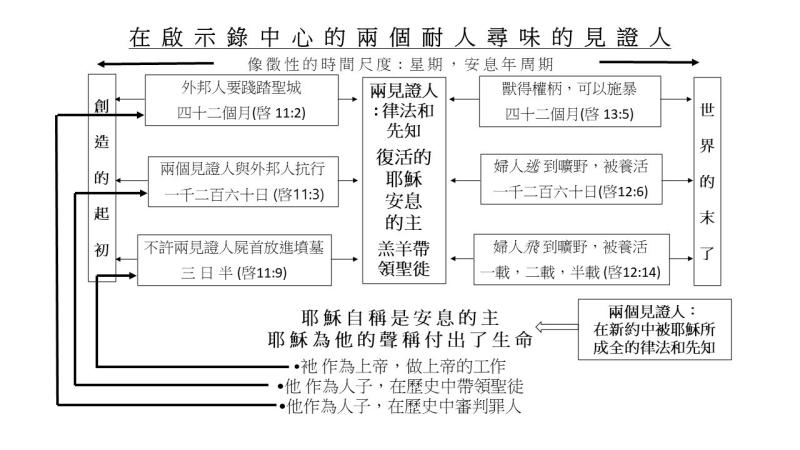
Thoughtfully, John has placed two resurrecting witnesses (representing Law and Prophets) in the centre of the two Sabbatical timescales (week for God’s work; Sabbatical year for man’s work to bring God’s creation into the Sabbath). Before the resurrection is a set of half Sabbatical timescales (42 months, 1260 days, 3.5 days) and after the resurrection is the other half (42 months, 1260 days, ‘time, times and half a time’). (A month is 30 days.) Matching them up would form complete sabbatical timescales.
Months are set according to the moon which rules the night. Days are set according to the sun which gives light. Amazingly John has used months only for God’s opponents and days only for God’s followers without confusion, thus elaborating on how these people live – in darkness or light!
The two witnesses symbolize Jesus’ work in the OT through the Law and Prophets. After Jesus has fulfilled the Law and Prophets, he is represented by the Lamb from Revelation 12 onward. The same Jesus is moving God’s creation forward from the beginning of creation to its very end in the Sabbath, thus giving full meaning to Jesus’ claim in the Synoptic Gospels that he is Lord of the Sabbath.
Jesus’ resurrection, being the center of God’s work (3.5 days + ‘time, times, half a time’), would complete God’s intention for his creation. Jesus’ resurrection, being the focal point of the saints’ work (2×1260 days), would lead the saints to cleanse God’s created order. Jesus’ resurrection, being God’s pivotal victory over his opponents (2×42 months), would judge the sinners. This judgment is subsequently elaborated in God’s seven bowls of wrath. Because of Jesus’ resurrection, no one can escape him.
In setting Jesus in the middle of the Bible’s sabbatical timescales, John is also showing the end point towards which mankind and creation should strive: a person reconciled to himself through the works of his hand, as God was endeared to the creation of his hand in his Sabbath; man reconciled to the created order symbolized by the farmer learning and respecting nature’s abundant provision in order to live the seventh year of the Sabbatical cycle without agricultural activities. All these are indispensable foundations in the Jubilee year when people are reconciled to each other. God accepts all these as concrete proof of man being reconciled to God himself. Creation can only proceed when these three reconciliations (man with himself; man with the created order; man with other people) happening under God progress together.
When God concludes his instructions to mankind in Revelation, he restates his original intentions for a cosmic harmony to be brought about by humans and sets Jesus to lead wayward humanity back to the original journey towards God’s intended Sabbath.
Currently, there are many signs of God renewing his creation through his people. These point to a greater harvest.
Saints are victors in Christ, not tragic heroes.